
Research
Design and Make Challenge 2025: An Open Project for Young African STEM Innovators
DMC2025 was an open innovation challenge by Dialogic Engineering under the Dialogic Open Research and Innovation Fund (DORIF), designed to empower young African students to develop practical, solar-powered solutions aligned with the UN Sustainable Development Goals. With over 60 applicants and 53 fully sponsored participants, the challenge promoted innovation while developing skills in engineering, digital design, teamwork, leadership, research, and project management.
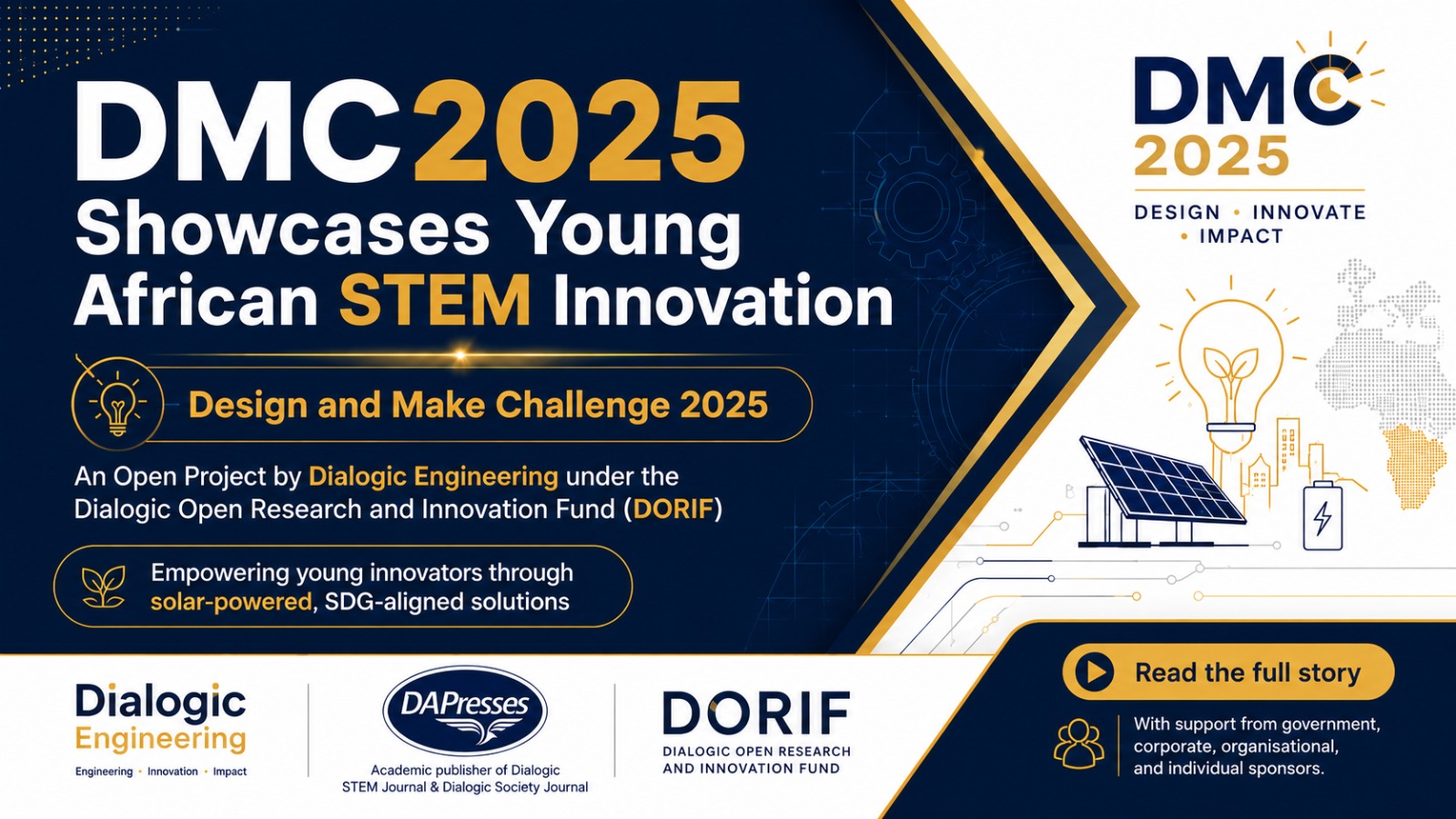
Design and Make Challenge 2025 (DMC2025) was created by Dialogic Engineering as an Open Project under the Dialogic Open Research and Innovation Fund (DORIF). The challenge was designed to inspire young African undergraduates, graduates, and PhD students to collaborate on ambitious, solar-powered innovation projects aligned with the United Nations Sustainable Development Goals (SDGs).
DMC2025 focused on practical projects addressing the needs of local communities across Africa. It was supported by government, corporate, organisational, and individual sponsors to enable participants to learn and engage without financial barriers. To further motivate participants, financial prizes were awarded: N500,000 for 1st place, N300,000 for 2nd place, and N200,000 for 3rd place.

DMC2025 sponsors and partners recognised for supporting young African innovators in solar-powered, SDG-aligned problem-solving.
The challenge was designed to help participants develop and apply transferable skills in digital design, engineering, communication, teamwork, leadership, problem-solving, research, technical writing, and presentation. These are critical skills required by companies, public-sector organisations, and innovation-driven institutions across the world.
More than 60 applicants expressed interest in DMC2025, with 53 applicants meeting the minimum threshold and receiving full sponsorship. The challenge began with a project briefing session, which introduced the sociotechnical context of the projects, clarified expectations for teamwork, and guided participants on how to apply lean and agile project-management methods in a fully virtual environment. The briefing document provided detailed tasks, challenges, assessment criteria, and assessment weightings.
Project briefing recording:
https://youtu.be/BvbU6ZzbEWo?is=EEaHwkYD2GT3nHTe
After one month of independent work, participants were supported through a dedicated question-and-answer session.
Question-and-answer session recording:
https://youtu.be/TefffR_M7CI?is=3UZCnEI2Vu5skOmL
At the beginning of the competition, nine groups were created. At the end of Stage I, four groups advanced to Stage II: Group 1, led by Emeka Ikechukwu Ezekiel, worked on a solar-powered fruit juicer; Group 2, led by Oladejo Habitat Olamide, worked on a solar-powered fruit juicer; Group 4, led by Idika TrustGod Chimdiebube, worked on a scooter powered by solar energy; and Group 9, led by Obasi Chibuike John, worked on a solar-powered reading lamp.
Following the Stage II final presentation on 25 July 2026, and based on the technical reports submitted after Stage I, the groups finished in the following positions:
|
Position |
Group |
Project |
|
1st Position |
Group 9 |
Solar-powered reading lamp |
|
2nd Position |
Group 4 |
Scooter powered by solar energy |
|
3rd Position |
Group 2 |
Solar-powered fruit juicer |
|
4th Position |
Group 1 |
Solar-powered fruit juicer |
DMC2025 finalists’ presentation:
https://youtu.be/0p0ey2g1sik?is=H5b1i2RHcEeOssTh
At the end of the challenge, participants reported that DMC2025 had a transformational impact on their skills development. The overall outcome showed that project-based, team-based, and virtually coordinated innovation programmes can provide a practical and scalable model for developing young STEM talent across Africa.
Based on the impact of DMC2025 and the lessons learned, the model is recommended for adoption by governments, STEM-based corporations, development organisations, universities, and NGOs seeking to strengthen innovation capacity among young people. As an Open Project, the materials, briefing documents, and recordings have been made available to the public.
Dialogic Engineering welcomes sponsors and partners for future editions of the Design and Make Challenge and similar innovation initiatives across Africa and beyond.
For sponsorship, partnership, or further enquiries, please contact: info@dialogicsl.com